Friday, 5 March 2021

Online Workshop with Sheena Cameron and Louise Dempsey

 Workshop with Louise Dempsey and Sheena Cameron on Reading. I'm really looking forward to getting some insight into transferring what I learn today into my program for more able readers.

The Reading Book
Look at Goal Sheet to come up with a focus.


Summary of slides

A balanced reading programme - reviewing the approaches.

Guiding Principles and practices

We need to ensure that our reading programme caters for all three aspects of reading:
  • Reading for pleasure
  • Reading to support writing
  • Reading to learn.
Using Reading to support writing to pick apart what is in the text to use in their writing.

Teaching the reading process

The development of reading skills and strategies need to be tailored to the age and stage of the children. Developing a love of reading and developing oral language are crucial across all ages but neet to strengthen in the middle and senior primary years.

Becoming a proficient reader - when decoding is no longer a focus. Mainly focusing on comprehension. What you're reading and understanding that. Explicitly teaching how to find key points and how to infer.

During the middle primary years, students are learning to:
  • use a range of self-monitoring strategies to gain meaning from the text
  • understand more challenging vocabulary and words/phrases with ambiguous meanings
  • answer inference questions using evidence
  • summarise the main ideas in the text
  • give opinions about events and characters in the text
  • identify and discuss text features and organisation.

Text characteristics: 
  • More abstract and implied ideas
  • Some mixed text types
  • Varied sentence structures
  • Challenging vocabulary, including subject-specific words and words/phrases with ambiguous meanings
  • Figurative language
  • May include a range of visual information

During the senior primary years, students are working on: 
  • using a range of strategies to deepen comprehension — analysing text features and structure
  • comparing and contrasting events and characters
  • identifying and discussing themes
  • creating new understandings (synthesising)
  • giving opinions about the text (ideas, action, characters, effectiveness etc.) — identifying author’s purpose and discussing different perspectives
  • evaluating ideas in the text.

Text includes challenges such as:
  • complex plots, sophisticated themes and/or abstract ideas — non-continuous text structures 
  • academic and content-specific vocabulary
  • figurative language
  • challenging and descriptive language
  • varied sentence structures including sentences with a lot of
  • information.

Teaching the reading process

Comprehension

Thinking about what they should be focusing on from the sheet we looked at earlier. 
Synthesising is a Level 4 strategy because it is pulling apart the text based on what they already know as well.

We need to ensure that we are making time to talk. There are conversation cards in the oral language book. These have been turned into speech bubbles in the Reading Book, promoting prompts during discussions. Creates quality discussion.
Using quotes, similies and metaphors to prompt students thinking to analyse what they are meaning and thinking. Use a proverb a week to promote extended thinking.

Cracking the Code

Pulling it all together, including phonics etc, to pull it all together. Looking at non-words:

All three decoding skills are important in reading to build up our strategies to decode. Mini-lessons are great for this. Decode in reading and then transfer to encode in writing.

Using word building - morphology - to increase vocabulary in the classroom. "Tricky words" from the text.
More than half the words in the English language use prefixes, suffixes or are compound words.

**Give the kids a baseword and get kids to build upon that with their knowledge of prefixes and suffixes. Give 1 minute to get as many down as they can, then roam and share them with others. 

The most common prefixes and suffixes. 

**Use the Affix card templates and print them off for kids to use to build their understanding of language and for spelling programme. You can find more in the literacy place (Can go to the bottom corner and sign up to their newsletters.

**Word building grid - to add prefixxes and suffixes to add words. 

Self monitoring strategies


Fix - up strategies


A balanced reading programme


This is ideally what it should look like. This might be a four-day programme. The 5th day might include a sharing session where we are developing a love of reading and celebrating what we've done. Teaching how to use things etc, that can be used throughout the week.

Reading To

This is developing their Reading comprehension, which can be really engaging for some of the tricky kids. It makes tricky texts accessible and allows them to develop their comprehension skills without having to decode the texts. For kids that haven't read a novel independently, this can make it more accessible. 

In Chapter 3 there are some Weblinks to Audio and Visual Stories online. These include Radio New Zealand stories which include topics and celebrities reading aloud to students. Look for ways that they could be listening to stories.

Audio and video stories online

storylineonline.net            

 Shared Reading

Shared reading isn't always reading aloud together... so long as they can follow along, they can be reading along in their head.

There are Slide presentations that can be downloaded from the site (Chapter 4) There are also plans available too. 

It's important because we are modelling how to self-monitor or infer, how to find evidence etc, so they can do this at their own level when they are reading independently.

We really need to make sure that we are using a range of texts, which includes a range of publishers. How many kids can read a PM easily but get thrown by a Ready to Read at the same level?

Kids really get engaged by learning about a song fro shared reading. They can pull apart the figurative language in inferences etc.

Kids News (Australian based) differentiates the text for different reading levels.

Literacy Online has everything available from the government, particularly from the last 8 years, as a PDF and as a listening file.


Using Think pair share etc and modelling.

Vocabulary - pull out 6 -7 words from the text. Give each group of 4 a word and get them to decode the word and think about what that word meant. Use phonics, chunking and analogy. Then discussions around what the book might be about if these words are all in the book. Great for developing word meaning.

Having the objects/props available can be fantastic for developing meaning.
Predictions - Get the kids to write a prediction. Then get them to walk around and share their ideas. Then rewrite your prediction. This gets writing mileage. It develops practice at writing your idea. It also models changing your idea and making it ok to do that. Whiteboards can be really powerful.


Do one session "zoom in" with littlies, two sessions with older learners.

Puppets are great because they can make mistakes.

Read a page and the puppet makes a mistake. In an older class, you can use "tick and check" to self-monitor while reading the text. The text might be on the screen and you can use post-it notes on the screen. 

The third session, after two sessions of zooming in, looks at zooming out. It's a great way to focus on questions as well. If you model this in shared reading they can copy and transfer to guided reading sessions. You can teach something in shared reading to be utilised independently.

Drama can be used to combine the arts with literacy:

There are a set of drama cards to use in class with a book. 10 different activities. To get up and act out a series of events, rather than retelling. 

There are question dice available, which can be really good for getting away from the constant "Why?" questions.


Take one section from the shared novel for a focus for the week. 

Making sure that you have the evidence, from the book - "Be prepared to tell me how you know, from the text, when you answer."

Guided Reading

We've looked at making it more manageable and more realistic to get a bit more out of the guided reading lesson. Again making sure that there is more time to talk during the lesson. 

Guided reading seems to have a very High Stakes feel in New Zealand classrooms. If you are having a rich Shared Reading Programme, then it becomes another part of that rather than the be all and end all.
If you're rushing all the time, it's no fun for anyone.

Kids on the colourwheel, grouping on colours rather than numbers. Mixed ability is difficult in the junior school otherwise it becomes shared reading. You could have a child in two groups for a while until they fit into one group. Minimise the goals they're working on. A goal could stay around for a month to ensure multiple opportunities for practice.

There could be a class focus goal, with differentiation between book difficulty. 

Don't spend huge amounts of time on follow up activities for individual groups. If they're more generic it's more time sensible and manageable. Page 124 has loads of levelled goals for guided reading.

Modelling Books


SIt with the text while planning and write tricky words in the modelling book.
Again, sitting with the text and the modelling book... write key questions on post it notes.

It can be a great place for recording teaching points that impromptu crop up. Kids can take away the modelling book to work on things before and after their group.

Put the goals in the front (Group goal sheet - PM34

In Guided Reading, it's about the kids sharing their prior knowledge and predicting, whereas the teacher is just guiding it.


Writing down the tricky words.


Our job is to listen in, they can be reading in a quiet voice OR read silently. Regarding noise level, think about whether they are interrupting or disrupting each other. There is a strategy called "Tap & Check" where you can tap them on the shoulder and you get them to read a little to you in a quiet voice, then you tap out and tap someone else.

Student's don't:
      • Read in Unison
      • "Round Robin" read

Put a "Stop" post-it in their books to stop them from reading on.
Pointers that kids can use in their book to highlight tricky words as they go.
We could group a lot more broadly with our proficient readers (9 1/2-10 1/2). There's lots more flexibility to group them according to goals etc. Therefore not having so much going on. Makes it more streamlined and ensures you have less going on as the teacher.

Use of the 3 level thinking-frame to dig deeper.

Use of Pointer sticky notes in guided reading novel study:
  • Pink ones for people (anything you learn about the person).
  • Blue for anything about the setting.
  • Yellow for unfamiliar words.
  • Purple for characters.

 Interrupting calling out with "have a little think"... to ensure thinking time is extended. 

For when some kids finish reading before all the others. 
Older kids can be doing these things when they finish before the rest. They could write down one thing that they learned about something on the subject. 

Independent Activities:

  • Don't plan too many activities.
  • Activities can be across groups.
  • Consider letting kids move between activities when they are ready rather than when the teacher finishes guided reading.
  • Consider moving towards self management.

Plan activities so that kids get o go back to the text to deepen their understanding, reread, talk and be creative.

Kids work hard on something that is valued. No child in the world has ever placed value on a worksheet. How does this motivate them to have a love of reading?

StoryMaps are great for use across a range of texts and contexts. They're open-ended. They can be used to retell. 

Venn diagrams can be great for comparison etc. They could be written or drawn (the teacher can annotate). Ideas are on the Literacyplace.com/resources. (templates and exemplars). Reading/writing links can be supported by comparing the language features of two types of texts. 

How could you use a Venn diagram in your learning programme?

Use of detail dice. These are big in The Writing Book. 

Detail Detective Race

Students take turns to throw the dice and then everyone tries to find that detail in the text. 
"The barn owl's call echoed in the still night air" 
The person who finds the detail calls out "stop!" and reads their detail.
This can work in groups as well. The child rolls the dice and then shares back their relevant idea.

These are kept as a resource to be reflected back on and referred to. Older kids might: Choose three of the words and writes a sentence with them. The next week, the kids will choose the words.

Y charts - identifying what happens Before, During and After.

Sociograms - characters are written in circles, then arrows go between them to infer the relationship between them. 

Activities where kids can be reading independently:

Book clubs/reading circles
Provides an opportunity for learners to understand that people interpret texts in different ways. 
There are Role cards that can be printed off and laminated so that kids can use them independently.

Task boards, choice systems and contracts.


Task boards


To simplify, a variety of groups could be working on the same activity, with groups pulling out for guided reading. Makes it really clear what each group is doing when not with the teacher, as well as clearly defining when the groups are each seeing teacher. 

**Reading challenges such as book discussion cards (many of these can be downloaded PM17). This builds up oral language around books. Works great with Silent Reading.


**Author study - Combine with writing. Great link to summarising. Create a class bank of writing.
Can control the number of students at each station.

Makes it really clear what they are expected to do.

This is in the PM box 44
There are 4 section and 6 section pizza wheel contracts. 

Introduce it slowly, but it has a goal of keeping students working independently over a period of time.
Contract grids can be written up and signed to say when completed. Like a job card.

Reading response plan
This can utilise iMovie movie trailers. Busy and engaging. Get kids to make a QR code so that it can be attached to the book in the library so they can be viewed before reading.

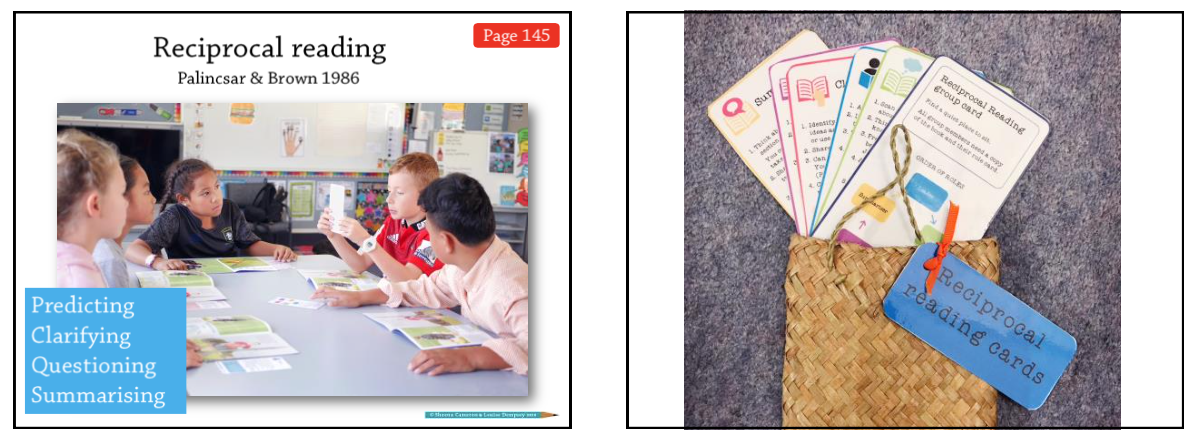
Reciprical Reading:

There's a slideshow in the online downloads that explains to kids what the different roles are. 
 A lot more intense than the book club. Lots of research around its ability to build comprehension strategies in more able readers.

Readers Theatre:

Can use with poem's too (e.g. Flanders Field)
LOads of scripts online. These can be reused as Independent reading.

Independent Reading

Sustained Silent Reading
Relax & Read
Drop Everything and Read
Sustained Quiet Un Interrupted Reading Time

The Role of the Teacher.

  • We need to be more explicit in what we do at this time. 
  • Set clear expectations about what they should be doing and why it's important. 
  • Reading interest inventory (PM50) Find out about your kids so you can get a sense of what they are all about and can find a way of connecting with them.


What next?

  • Look at Goal Sheet to come up with a focus.
  • Create a wall of prompts near the mat with speech bubble prompts.
  • Mini-Lessons - structured literacy approach - to build up the skills.
  • Book discussion cards - laminate and use after Silent reading.


Thursday, 22 October 2020

Manaiakalani & Outreach Wananga 2020 - From Theory to Reality.

Always an absolute pleasure to be welcomed to the Wananga by Point England School Akonga. 

From Programme to Movement.

Pat Snedden, MET Chair.

Spoke about the unique capability, responsibility and adaptation we have been required to be in leading the way for our communities in a time that hadn't been foreseen a year ago. Paid a great tribute to the innovation and moral purpose undertaken.

We need to communicate the ideas. WFRC is seeing that students outside the Manaiakalani umbrella are struggling and stressed. It's not fair that they are getting a raw deal through no fault of their own. 

Manaikalani has been approached by the government to be the commissioning agent for digital efficiency in low decile communities in New Zealand. Delivering foundation digital skills training for adults. All of the things that we take for granted, internet banking, digital communication, etc... Ways of getting our parents to have more skills and connectivity to get training in these skills. This will be free for our whanau.

WFRC

 Aaron 

 Online Observations and Q & A

The whole purpose of the data collected is for it to be used ina formative capacity in order to inform practice and changes needed. They redesigned the tool and ensured the reliability of the tool in an extraordinary year in education.

Initially, the patterns are looked at in regard to what the data is saying about student achievement and then looking for patterns around teaching.

Reading:

Having a relentless focus on reading.

The pattern of achievement is lower and so is the rate of progress. We need to disrupt the pattern. We have very strong evidence of acceleration in the early years of education. They start well below but make massive progress at getting closer to the norm. It's an intriguing pattern where the line tapers off after year 4. 


Shanahan & Shanahan Model of Literacy Development.

Basic Literacy: Decoding letting identification etc.

Intermediate Literacy: Being able to comprehend the text. Knowing the conventions of a variety of text types etc.

Disciplinary Literacy: Where the literacy demands become very subject-specific and specialised texts and vocabulary.


What it means for us is that we know that many of our children don't have those foundational skills. We need to intervene and get help for those kids. We need to be looking ahead at what they are going to need to be able to move towards. Our teaching is sufficient to meet the needs of what they are doing up to year 4, but not sufficient to enable them to progress to Intermediate Literacy. This is why High Leverage Practices have been identified. We need more of them to be seen in our classrooms to see a shift.


We know about all these things. The power of talking. These are the principles that underpin the interventions that need to be made.

In the junior years of that solid foundation, this is what that would look like:


Reflecting on the data that is informed by that framework...

Teachers were asked for access to their sites, texts, planning frameworks etc. The information was observed across a whole week instead of the 30-minute snapshot that was used prior to this. Aaron has recognised that this gave them a wider criticality about the planning of the lesson. The quality of planning for the discussions taking place. To develop critical literacy, their needs to be deliberate acts of teaching and discussions. The spontaneous discussion will never be enough. 

Limited opportunities to read extended texts (100pages or more than one hour of film). The majority of the texts were short texts. Q: What would be the optimal balance and how could this balance be more affected?


Q: Do we have a balance of exposure to a range of literary texts at different year levels?

Evidence of an increase in multiple text use, which hasn't been seen previously.

The texts that we are reading predominantly represent the dominant cultures. whereas the overall ethnicity breakdown sees Mōari 36%, Pasifik 16%, Asian 9%, NZE/Pakeha 36% and Other 3%. 

A mirror text is where you read the text and it reflects me. It's like my community. 
A window text gives an outward view of a world different form me.
Ideally we want a text to be both a mirror and window text.
What opportunities do our ākonga have to have that window and mirror of non-European cultures around the world?


 What is the text diet that our students are being offered? Is it optimum to accelerate reading?

The majority of class sites showed no evidence of any focus on audience and purpose within that one week. It doesn't mean its not happening, it could be that its done face to face. This aspect is really important in developing critical literacy skills. It's imperative. Audience and purpose are vital.

Strong focus on vocabulary. Not a visible focus on poetic devices. Texts tend to get more figurative as they develop complexity. Minimal evidence of the teaching of the structure of texts for that one week. This could be coming up when teachers are modelling. Is it enough when it should be evident in planned activities.

The emphasis didn't go past plot. Limited ideas of characterisation, atmosphere and some thinking about the ideas.

This needs to be planned and emphasised. If it's not visible to WFRC and they are looking hard for it, then how obvious is it really for our ākonga?
Most class sites showed no evidence of any focus on inference, analysis, critical literacy or critical thinking. We need to analyse all of our tasks and what's on offer for our kids and going it a nudge. Is it enough?

When looking at blogs, what was the highest level of thinking required of students on their blogs? The reason they're not elevating is that the level of task expectation on the site. we can't expect the students to exceed the limits of the task that has been set up on the site. We are creating a ceiling. 
Is working hard the same as thinking hard?
There was a minimal representation of rewindable tasks evident within that week.
If we are going to push the expectation for students to. be more dialogic then there should be more planned discussion visible. There is still a propensity for DLO's to default to slides, with minimal extension. Minimal opportunities for choice and agency over text and task. Most choice was over order of task.

Oral language  - South Hornby have had a massive focus on its and are seeing success. They assess oral language on school entry. Do we do this?

At the time this data was coming back there was a caveat that we were trying to get our kids back and engaged. It may explain the time we are at, but we need to move it forward. It's matching evidence to practice. 

Manaiakalani Innovative Teachers

Accelerating Reading Comprehension through questioning

Sarah Daly

Noticed that Levels 22-23 (Purple, Gold, Silver) became stagnant and there was a struggle to progress. Assessments up to then are generally literal and it is a big jump from there, particularly for ESOL students.


Learning Through Listening

Alethea Dejong

How to enable students to listen to each other in an independent group. Talk Moves and DIMIC maths helped develop strategies to address these problems however they didn't teach students the skills to listen. Teaching "response" and "initiation". explicitly teaching listening behaviours and expectations.


How can we develop students to be better writers?

Tanya Mundy

Is as a teacher, we can't get motivated to write, then how can we motivate our students to write. After undertaking a writers course as an adult, she wondered why these skills couldn't be taught to students.


Device & Finance Procurement for 2021

Acer Insurance:

3 Years
2 Repair claims
1 Replacement

Explain Everything licence is cheaper.

Devices for Livestream


Manaiakalani Innovative Teachers

Transitioning students

Kiriwai Tapuke

Utilising Te Whare Tapa Wha to help develop connections with students to assist with effective transitioning for students. 


Algebra as a key pathway to senior math

Angela Seyb

Weaknesses in ākonga arriving at high school with little algebraic thinking. Children often have a misunderstanding of variables. The trinity between graph, equations and tables. Big Ideas were developed that learners needed to understand. They needed to engage the students, utilising Jo Boaler etc. Focusing on Mathematical Literacy and problem-solving. DESMOS as a tool. The focus was on Level 2,3 & 4 resources.


Ka Rere te Reo

Kerianna Stirling

Having students struggling to understand the language that is being spoken in the classroom makes it very difficult to learn. Oral language is more than speaking and listening. It shapes every aspect of our lives. Created an online tool for teachers to assist students in developing their oral language.


Reflecting on 2018-2020, looking to 2021 and beyond - Dorothy Burt

2020: From Theory to Reality. Where we've seen the theory of the Manaiakalani principles become the reality for schools throughout the country.


Committed to providing the framework for what learning looks like in a future-focused framework. The memorandum of Understanding reflects the seven strands that are crucial to the foundation and roof that is secure to enable us to be safe within.

This year saw us having to leap at the challenge to this with the bot that began to attack our ākonga's blogs. As a team we reacted swiftly and strongly.

In the centre of our houses, we are able to insert our own flair. He Pātaka Matihiko: A food storehouse.
The whakatauki talks of eating and eating well, but once you've eaten you store away the leftovers for later eating. While being known as a warring people, Māori were also great planners. They had to plan for the future, planting etc.
I te Ipurangi - Cybersmart
Atamai - being sharp of mind, open-minded and deep thinking.
Learn. Create. Share. are the walls and floors.
Below are the pillars to keep our kai safe. If the roof is not secure your food will spoil and go to waste.
The knowledge within your Pātaka is up to you.

Challenge: We have ShakeOut drills, Lockdown prep... we also need to Meet Up. Access the barriers to accessing learners when they are with us. Use the time between now and the end of the year to ensure our kids are ready in case it happens again. Practising the protocols and procedures.

DFI 2021.

there will be one face-to-face and three online DFI's. It is recognising that it's not just abut not being digitally savvy, some people aren't suited to showing up...

Summer Learning Journey

It's being extended to 6 weeks of learning. It's being collaboratively designed by our teachers. Volunteers are writing 2 activities each.

Virtual Cluster

A new initiative for individual schools who don't have the consensus of their wider cluster. Schools interested can apply to join this virtual cluster with the support of the Manaiakalani Network. Contact Jenny Oxley.

Manaiakalani Innovative Teachers

Develop a digital Tool for enhancing engagement

Sonali Carter

Impacts on self-regulation with deficits from a wide range of aspects. Developing key social skills to enhance their presence in the classroom. Developing engage activities and games to teach skills to priority learners. These showed a clear development in students using full sentence answers rather than two-word combinations. Consideration was given to student experiences in lockdown, with thoughts about who was caring for them while parents may be working and how this may have impacted. (Does this link with Theraplay?)


Partnering with Whanau to implement the school-based engage programme at home.

Jo Gormly

Many students have experiences at home which impact their ability to engage at school. Regulation Difficulties etc. Could teaching self-regulation skills be the tool for raising student achievement? Research shows play is about how a child learns about themselves and their environment. Is this a true reflection of our Pasifika community beliefs? The heritage languages of the students are utilised.

The Challenge/Provocation

In our classes, we have learners with multiple learning needs and many who need the foundations. The challenge is to build them alongside more sophisticated comprehension skills as well. There is still a need for a relentless focus for accelerating reading. The pattern for reading has stayed the same. If we don't change our teaching and the classroom experiences then we won't change the pattern. REading like a writer and writing like a reader.

We need to seriously consider what we do about Mathematics.

We need to be thinking about our windows and mirrors. How are we going to engage our readers in reading if they are not seeing themselves reflected in the reading at a proportional level. We need to look at the representation of texts and activities for Pasifika students and our diverse learners to engage them in literature development.

We need to pay particular attention to the floor and ceiling. We need to raise the ceiling so that all of those cognitive aspects are challenging our learners. If we shift the task then the learners will meet them. It can't just happen in one house or in one room. We need to put the responsibility on all individual teachers and bring everybody together so that every individual isn't having to locate the resources to reflect their class. They can be pooled and collated. As leaders, our challenge is to create opportunities to create these resources and environments. It's about Reading development and sophisticated literacy.


Take Away Pondering:
How can we capture the engagement of tasks such as Sumdog and prodigy, but use it to specifically target acceleration in developing Mathematical knowledge in our learners?

Thursday, 10 September 2020

Student Design for Learning

What are DLOs?

Digital entity or content object using ‘different media modalities (and often interactivity) to represent data, information, reality, concepts and ideas…designed to afford educational reuse. - Churchill, 2007, p.484


Student Design for Learning (SDL)

The potential for enhancing learning, by the process and the product. How potentially can we think of all of those principals (MAPIC) in designing learning for students that enhances the potential for learning through the DLO.


Student Multi-Modal Design for learning
Authentic purpose / Audience.

Creating a Prescribed Checklist to include in the task:

The items in the checklist are design features.
The features will help others learn from the video.
We control the constrains of the task by designing what we include or don't include. e.g. adding in key vocabulary that you want them to include in the checklist.


The Five Modes

A mode, quite simply, is a means of communicating. According to the New London Group, there are five modes of communication: visual, linguistic, spatial, aural, and gestural.
The five modes of communication: visual. aural, gestural, spatial,. linguistic
UM Letlad


New Tools:

So What?

  • How much do we utilise the blog comments of peers in their own class for feedback etc?
  • Nudge tasks and expectations. We need to give students opportunities to create media for sharing.
    • Moving from Slides to Screencastify. 

    • Getting students to use their voice to explain their thinking in their own words.
    • Students nudging up their poetry posts... how can they include audio? 
      • Reading aloud and using their own voice etc - 
      • ScreenCastify, highlighting the poetic devices.
  • GO back and look at "Interactions" slides.

Sunday, 30 August 2020

Murray Gadd observation

8 steps to get a good a good writing lesson

1. Helping the kids to develop a topic (What are we gonna write about)
2. Develop the content. (I know what I'm gonna write about... possible content.)
3. Establish a task... (Am I going to use the content to persuade/inform)
4. Develop some success criteria (What am i going to have to good at to do this well?)
5. Demonstrate How to get ready/prepare/plan etc
6. Differentiate - who can have a go at doing this by themselves? WHo needs guidance/modelling etc
7. Teacher Roving (Who do I need to got to and what conversations do i need to have a long the way.
8. Sharing/celebrating

Instead of starting with the topic, establish the emphasis on content rather than the purpose of the lesson.

Emphasis on Topic for writing rather than the tool for writing.

Lock all that in your head, cos we're gonna use all of this.


Restorative Practice

I'm pretty certain that, even if you've been dwelling under a rock for the past few years, if you've been anywhere near an education setting, then you will have heard about Restorative Practices.

We all like to think that we are being fair and just when dealing with situations and individual students... That we've built these great relationships with learners and whānau alike... But if we are honest, there is always that one individual who doesn't fit the mould with what works for all the others. The one that we don't have the same relationship with.

I've been delving into restorative practices with a specific lens of late. I'm finding a specific individual tricky. They have come to us with a history of "stuff", some known... a lot unknown. I've been discussing their situation with our RTLB, who has pointed me in the direction of all of this.

Restorative Practice is a relational approach to school life grounded in beliefs about equality, dignity, mana and the potential of all people.
If I'm brutally honest, I'm not treating this individual with as much mana and respect as I should. I've been becoming frustrated at their lack of empathy for others... yet where has my empathy for her been?

continuum-of-restorative-practices_orig_0.png
A useful way of looking at how the restorative approach works within a school community is the Social Discipline Window (Figure 1). This model’s four quadrants identify four sets of attitudes and responses to behaviour.
The top left quadrant is high on structure and expectations but low on support and care. This results in a punitive and authoritarian approach in which actions are done to others.

The bottom right quadrant is high on support and care but low on structure and expectations, resulting in approaches that appear permissive and rescuing and that do things for others.

The bottom left quadrant is low on both expectations and care. It is inherently neglectful and does not do much at all.

The top right quadrant is high on both structure and support. This approach most often results in respectful problem solving, collaboration, ownership of issues, and restoration with others.


What next?

I need to try Restorative Circles. (Book 3)

Restorative Circles support all staff and students to develop and manage relationships and create opportunities for effective teaching and learning time. They are a semi-formal practice requiring some preparation. They provide teachers with a range of processes to build relationships with and between all people in a school community, maintain those relationships, and enhance positive communication.

Restorative Conferencing is a process that provides schools with ways to repair harm and restore relationships. It uses the stories of those involved in an incident and the people close to it (e.g. students, staff and whanau) to:

  • explore what has happened and who has been affected
  • hold those who have caused harm accountable for their actions
  • provide support to those who have been harmed, and others involved.

Why is this important?

Schools have a critical role in forming future citizens, and when schools teach and model restorative ways of handling conflict and wrongdoing, they contribute significantly to the creation of a more peaceful, humane and democratic society

Wednesday, 15 April 2020

Redefining Learning for a Rāhui

Today was a day like no other in my teaching career.  I have huddled under a desk (Yes I had one then!) while my classroom was upended with an Earthquake. - It was only when allowed back near it, I realised the levels of damage as scanning the room for anything other than learners wasn't a priority at that moment in time.

Today Term two began with me rolling out of bed, past the jug to throw a coffee together and then hitting the couch. I set myself up with my laptop on the ottoman in front, a diffuser nearby sending a calming aroma throughout the house.

There was a slight panic as I attempted to email a link to parents through Hero, which we have literally just migrated to from Linc Ed. The migration has had a few glitches, included not transferring some emails across! As always when using a new tool, it's a little different from what you're used to. I couldn't find how to send it to just my class. A mayday call to my team had that sorted and I was away.

I waited...

I spent a little time commenting on the few blog posts that had been put up on individual blogs over the last week or so. Paperwork was caught up on. And I waited...

My big lesson for the day came with a screencastify to help one of my class members siblings get access to his blog. He should have had it bookmarked prior to the rāhui, however, somehow slipped through the cracks. After sending instructions via email... then messaging him step by step... I took a few moments to make a screencastify. This is were my lesson came in. You may have noted when I described the start of my day that at no point did I mention having a shower or getting dressed. I spent the day in my dressing gown with my hair looking like it hasn't been done in days (Maybe it hasn't...?)
In the interest of documenting this momentous occasion, I'll post it here... in a bid to remind me never to repeat this again!
My best friend today... something I have come to rely on quite a lot, is my daughters A4 school whiteboard. I'm using this for all sorts of things, from draft timetabling to scriptwriting and note-taking. I need this in my life right now!

My high for today was watching my daughter participating in the Les Mills Kids exercises on the Learning Channel (Sky Channel 502) today. It was great and she was right into it.
Image may contain: 2 people, indoor

Her 11-year-old brother, on the other hand: "I'm having no part in that!"

To prepare for this Learning time we are posting a video each morning and outlining tasks for that day. Here's yesterday's video:


Tomorrow, I want to set a few challenges to grasp how much engagement I actually have. I want kids to email or message me. I've also scheduled a Google Meet to touch base with them. It'll be interesting to see how many touch base.

Saturday, 14 December 2019

The Creative Brain

What's a Saturday morning with no sport... Netflix has provided! Check out the preview:
This morning I fell upon THE CREATIVE BRAIN. It promised to take audiences on a journey with neuroscientist and best-selling author, David Eagleman, to meet accomplished professionals from across the creative spectrum, unravel the creative process, and encourage all of us to be more creative.

As teachers, it's crucial that we understand this concept. We are in the creative age (not the digital age, as some still believe). Creativity is a fundamental piece that our educational experiences are lacking. WFRC has been telling us this for the past few years, however I think teachers lack the understanding of what that means. It's not "creating", in the traditional sense.
Creativity is the ability to take on new information and put it together with what we already know.
Humans have transformed the world we live in like no other species. People often link creativity with the arts, however, it is so much more than that. To consider what doesn't exist. To rise above our instincts and consider our other options before deciding what to do.

Most animals have the input and output parts of the brain right next to each other, so there's a direct path between the two. There's an instant reaction. Not much happens in between. Our brains are wired differently, we are able to disengage our instinct to see it differently. Input can collide with what's already there to forge new pathways, make new connections... considering possibility based on what's already there. We can process information in limitless ways. The enlargement of the human cortex, the expansion of the prefrontal cortex behind the forehead... This gives us imagination.

Being original is not about generating something out of nothing

Michael Chabon - Novelist attempts to debunk the theory saying there never has been such a thing as a truly original idea. A Pulitzer Prize winner that's not afraid to take ideas from anywhere, he operates on a basis of instead of "how can I make mine different from my predecessors? How can I utilize what they did to make mine better?"

What we create is unique because our life experiences are unique.
It's about getting out into the world and generate new concepts. Take the ordinary and make them extraordinary by putting them in a yet unseen combination. The creative process often involves making something, yet it also has the power to remake our lives.

Ehron Tool - Potter. He was a Gulf War veteran. He came back with a notion to do something different with his life. His creative outlet allows him to create discussion, generate a feeling. It's become a real healing process.

Lafayette Correctional Centre runs a groundbreaking programme by writer Zachery Lazar. His father had been murdered and this impacted his entire life. Upon visiting a correctional facility as a journalist he realised something surprising. He was surprised by a connection he felt to a lot of the people he talked to. He felt that there was a real lack of creativity in the prison. He felt that by harnessing those people's creativity, it could be a way of preventing them from being in the prison cycle. He now works with the prisoners to nurture their creative writing skills. The impact has been described as helping them think differently about things, think differently about themselves and think differently about other people. They are able to see themselves. It's about changing the narrative.
Tim Robbins (of Shawshank Redemption fame) runs acting workshops with prisoners. Often prisoners are defined by their mistakes made and any potential is never considered. By telling them that they are defined by who they are as human beings. The emotions that they suppress are real emotions. Prisoners taking part in these programmes are up to 80% less likely to re-offend.


Michelle Khine of Shrink Nanotechnologies, combined her childhood experience with Shrinkydinks and utilised it to advance science, by creating the tools she needed.
In order to advance science, you need to think about things in a different way otherwise nothing changes.


Bjarke Ingels is a Danish architect renowned for his imaginative designs. He operates by using a lot of material on hand to mash it with what is in his imagination. We have the power to imagine a world that isn't our world yet.

He blended his idea of lego with preconceived notions of a house. A ski field with perceptions of a building.


Image result for nathan myhrvold Nathan Myhrvold - Bill Gates described him as the smartest man he knew.
Taking ideas from one place and putting them in an entirely different context. He surrounds himself with influences.


"It's always better to be a critic than a creator." Nathan Myhrvold


Creativity is the interplay of billions of neurons sending trillions of impulses. Every experience you have is a raw material for your brain to create with and fashion into new ideas, by bending them into something new.

It's all about refashioning what already exists

Phill Tippett - Animator and Monster Maker.
He has a things and ideas room filled with "junk and stuff I've picked up over the years". He has organised it into an ideas generator. He randomly cut out pictures and put them into a book. He described the feeling of "I got it" when using them. It's an ability to put disparate information together and make something useful.

Robert Glasper - Musician
Jazz is a mashup of other forms of music. All of the forms of music that were around at the time was pulled together and reflects the time it was created in... it's always changing. If it stops changing then it's not following the tradition. If people of the previous generation are saying "You're not doing it right" then you are doing it right.


3 ways we can take advantage of how we are wired:

1. Try something new.

Being creative means fighting the instinct of not choosing the path of least resistance. Our brains naturally default to what we've done before. We need to dig deeper and get off that path of least resistance and try something new. For adults, this often translates as a career change. I've heard of the idea of getting kids to generate the first 3 ideas that spring to mind, then drawing a line under them and saying "You can't use this." Specialisation can mean 'learning a lot about less' can transpire into 'knowing a lot about nothing'. To be able to think outside the box you have to be willing to be wrong. You also have to be willing to be right when everyone thinks you are wrong.

2. We have to push boundaries. 

Our brains are novelty seekers. There's a fine line between exploring the range of possibilities between the familiar and the unfamiliar. Being willing to turn your back on traditional unwritten rules and test ideas that might be considered "wrong". Things that are considered "weird" are things that people are unfamiliar with. If it is considered weird than it is pushing boundaries. There's a spectrum between too familiar and too far out and wacky... its the in-between that is where the magic happens. tp create something that's not too new too unfamiliar but something in between.

3. We need to risk failing. 

Failure feels awful so we avoid it. The reality is that most peoples successes arise out of the ashes of their failings. Game of Thrones co-creator and writer, D.B. Weiss describes himself as failing very consistently for a very long time. He learned to be less worried about failing. All of the failures ultimately contributed to him being able to do this thing.

A school transforms...

10 years ago a Vermont School was on the verge of being shut down. Poor community. Terrible test scores. H O Wheeler. to save the school they decided to put creativity and the arts at the heart of every subject
When can kids learn? When they're engaged. - Bobby Riley (Principal)
When you focus on the arts and the process of the artistic experience, then they are able to blossom in unique and very special ways.
Learning geometry through the medium of abstract art. When it is integrated it hits more avenues that different learners use to access information. With creativity at the heart of every subject, the kids are learning a creative mindset. They're being taught to get off the path of least resistance and keep trying. It's about teaching them to try their best and to take a risk. It's about developing the process that allows them to interact with the world around them.

To succeed in an unimaginable future we need to instil creativity in our the children we teach so they can be successful in navigating that world.

How can we instil more creativity in our akonga?